
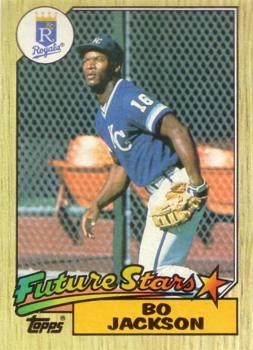
Welcome to Wax Pack Memories, where I’ll go through some of my boxes of 1980s and early 1990s baseball cards, and write about some interesting players, trends, or topics I’m finding from the era. In the debut edition, we’ll talk about one of the most iconic, short-term players in baseball history: Bo Jackson.
Bo Jackson was a superstar in the MLB from the getgo. The Kansas City Royals drafted the Heisman Trophy winning Jackson in the fourth round of the 1986 MLB draft, and despite being drafted first overall in the NFL draft by the Tampa Bay Buccaneers, Jackson signed with the defending World Champion Royals when the Bucs wouldn’t let him professional baseball as well as football. Jackson started his season in AA with the Memphis Chicks in ’86, and after a 53 game stint in Memphis, he was called up to the majors for good. In his 25 games in the majors in ’86, Jackson had a .615 OPS, striking out 34 times in 82 at bats. But the Royals had a phenom, and a marketer’s dream, and couldn’t send Jackson down to the minors.
Jackson had three rookie cards produced for the 1987 card season, in addition to a couple in the late season releases of 1986, which were much less distributed and less popular among collectors of the time. The three rookie cards, Topps, Fleer, and Donruss, are all relatively readily available, and look rather iconic in their own way.


“Posed” cards, like you see in the Fleer release above, were huge in the 1980s. Probably a good 2/3 to 3/4 of the cards released feature the player standing there, with a smile on his face, in a photo shoot type picture. Action shots were rare, but not necessarily reserved for the superstars. These three cards all have their own special thing going on. The Donruss card features Bo in the beautiful powder blue Royals uniform, and it’s partially an action shot, featuring him just after throwing a ball. The Donruss card also features the coveted “Rated Rookie” label, normally reserved for about 20 players in every Donruss edition. There are other rookies sprinkled throughout the set that don’t feature the RR label, however. I like the Fleer version the most, featuring Jackson in the powder blue, but a posed position. The Topps version looks like it was taken during Spring Training, with Bo in front of a chain-link fence in a dark blue jersey that appears reminiscent of a batting practice jersey. The Topps card also features the rather rare “Future Stars” rainbow caption. While looking a little tacky, the label clearly tells fans to expect a lot out of Jackson.
As Bo’s career went on, he never really became the superstar many imagined, probably because he never got much of a chance to hone his game in the minors, and probably because he was a much more natural football player than a baseball player. In his four full seasons from 1987 to 1990, Jackson hit at least 20 homers in each season, while also striking out at least once per game. The speed that made Jackson such a dangerous football player was also there, as he stole 20 bases in two of those four seasons.
The 1990 season also resulted in the release of one of the most desired cards of my youth being released in the ultra cheap Score set. The card featured Jackson wearing football pads, and holding a baseball bat over his shoulders. The image was in black and white. It was one of thoe cards that every kid NEEDED to have.

Just by looking at that card, you can see why it was so popular, right?
Unfortunately, the career of Jackson would change forever after the 1990 season. His hip popped out of the socker in the 1990 NFL playoffs with the Los Angeles Raiders, who Bo was playing with once the MLB season ended from 1987 to 1990. Legend has it that when Jackson initially got hurt, he popped his hip back into place. After surgery on rehab on the hip, doctors discovered that Jackson had a disease in his hip called avascular necrosis, which would eventually necessitate a replacement of his hip at just the age of 28. The Royals released Jackson in the spring following the injury, and Jackson signed with the Chicago White Sox. He’d debut with the White Sox in September 1991, functioning at the team’s DH. He struck out 25 times in 71 at bats, didn’t steal any bases, and hit just three homers.
That pretty much ends the legend of Bo Jackson. He missed all of the 1992 season, and played in just 85 games in 1993, hitting 16 homers, and striking out 106 times. In the strike-shortened 1994 season, Jackson played with the California Angels. In 75 games, he hit 13 homers and struck out 72 times. He got a decent bit of time in the field for the Angels, but a majority of his at bats came off the bench. After the hip injury in 1990, he never stole another base. Jackson was out of baseball at age 31, with a career .784 OPS, 141 homers, 82 stolen bases (at a career 71.9% clip), and 841 strikeouts in 2626 plate appearances, a 32.0% rate. Of all players with at least 2500 career plate appearances, that strikeout rate is third highest of all-time, behind Mark Reynolds and Russell Branyan.
Jackson had a number of career highlights. He was the 1989 All-Star Game MVP. He ran up walls, made incredible diving catches, and had an absolute cannon of an arm. For five years in the late-1980s, Jackson was one of the brightest stars in the game, even if his overall performance wasn’t without flaws. Every baseball fan knew who Jackson was, and most were absolutely amazed by his abilities. Jackson may not have been the best baseball player of his era, but he was one of the best athletes, and that led to some incredible highlights during his baseball career.
http://youtube.com/watch?v=XoMDhzDQQmU

